

Understanding expected returns is more useful than relying on bright graphics or occasional large wins. The phrase sweet bonanza can refer to the original candy-themed slot, but its advertised RTP is not necessarily identical at every casino. The practical question is therefore not simply whether the game has a “good” percentage. It is which RTP configuration is loaded, what the figure means over time, and how volatility affects the results of individual spins and sessions.
What does the RTP percentage actually measure?
RTP means return to player. It is a theoretical percentage calculated across a very large number of spins. If a version of the slot has a 96.50% RTP, the mathematical expectation is that $96.50 of every $100 wagered would be returned as winnings over an enormous sample, with the remaining $3.50 representing the theoretical house edge. This is not a promise attached to one player, one day or one deposit.
The calculation includes all built-in outcomes, including ordinary symbol wins, Tumble sequences, Scatter awards, Free Spins and multiplier effects. It does not mean that each spin returns 96.50% of its stake. A spin can lose the full amount, produce a small win, or begin a sequence that creates several wins before the round ends. The percentage only becomes meaningful when results are aggregated over a very large number of rounds.
RTP is also separate from the maximum win. A game may have a theoretical return near 96.5% and still advertise a possible win of many thousands of times the stake. That large outcome is rare and does not raise the expected return for an individual session. Players should treat RTP as a statistical model for comparing configurations, not as a target, a balance guarantee or a way to predict the next result.

Why the loaded version matters more than a headline figure
Published information for the original slot includes RTP configurations in the area of 96.48% to 96.51%. Those figures are close, but they are not interchangeable if a player wants to identify the exact mathematical setting being used. An operator can enable a particular configuration, while the provider’s general material may describe several possible versions.
The most reliable place to check is the game’s own information screen after it has loaded at the chosen casino. Look for the RTP, paytable or rules section rather than relying only on a search result, an old review or a promotional description. The displayed value should be read alongside the game title and version, because later related releases are separate products with potentially different mathematics.
Checking the screen also helps avoid confusing the original game with titles such as Sweet Bonanza 1000, Sweet Bonanza Super Scatter, Sweet Bonanza 2500, Sweet Bonanza Xmas or Sweet Bonanza POP. Similar artwork or naming does not establish that the games share the same RTP, mechanics or maximum-win figure. If the information screen is unclear, the operator’s support team can confirm which configuration is available.
How Tumbles and Free Spins shape the result
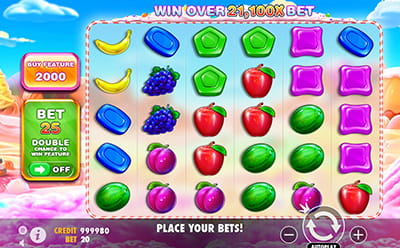
The slot uses a 6×5 grid and a Pay Anywhere system. A qualifying win requires at least eight matching symbols anywhere on the screen, rather than matching symbols along a traditional fixed payline. After a win, those symbols disappear, the remaining symbols fall into the empty spaces and new symbols enter. Additional wins can therefore occur during the same paid spin.
This Tumble structure affects how results feel, but it does not change the meaning of the stated RTP. Several small wins may be added during one sequence, while many spins may end without a qualifying combination. The game’s return calculation accounts for these connected outcomes. A short session can look unusually strong or weak because the observed result is still dominated by chance.
Four or more lollipop Scatters trigger the Free Spins feature, normally beginning with 10 spins. Three or more additional Scatters during the feature add five spins. Multiplier bombs can appear during Free Spins, carrying values from 2x to 100x. Bomb values in an active Tumble sequence are added together before the resulting multiplier is applied to that sequence’s win. These features contribute to the overall mathematics, but their presence does not make a particular bonus round likely or profitable.
RTP is not the same as volatility or winning frequency
RTP answers one question: how much the game is theoretically expected to return over a very large sample. Volatility describes another: how frequently wins may arrive and how widely their sizes can vary. A higher-volatility game can produce longer stretches without meaningful wins followed by occasional larger outcomes. A lower-volatility game may produce smaller wins more often, without guaranteeing a positive session.
This distinction matters when interpreting a short trial. A few spins cannot verify the published RTP, and a free-demo session using virtual credits cannot demonstrate what will happen with real stakes. Neither a lucky feature round nor a losing sequence proves that the game is malfunctioning or “due” for a win. Random outcomes do not compensate for previous results.
Stake size also does not improve the RTP percentage. Increasing the bet changes the dollar value of wins and losses, while reducing it changes the amount exposed on each round. Some operators may offer an Ante Bet option that increases the stake by 25% and changes the chance of triggering Free Spins, but that is a separate game setting and may alter the practical experience. Any available options should be reviewed in the information screen before use.
Which checks should you make before playing?
Start by confirming the exact game title and reading the in-game rules. Record the displayed RTP, minimum stake, maximum stake and any optional features. The published bet range can differ between operators and currencies, so an amount seen elsewhere should not be assumed to apply to the version available to you. Also check whether Bonus Buy is enabled; where permitted, the documented price is 100 times the selected base bet, but availability varies.
Next, separate game information from casino terms. The slot does not determine deposit methods, withdrawal processing, account verification, bonus wagering rules or promotional free-spin conditions. Those matters belong to the operator. If bonus funds are involved, read the maximum-bet rule, expiry date, wagering requirement and game contribution before making assumptions about withdrawable funds.
Finally, compare the RTP with the amount and time you are prepared to spend, rather than treating it as a reason to increase your budget. A theoretical edge remains an edge over the long run, and short-term results can move sharply in either direction. Keep records if useful, stop when the planned limit is reached and ask the operator about any unclear configuration or account control.
RTP questions Canadian players commonly ask
Can the RTP change between Canadian casinos?
Yes. The provider can publish several RTP configurations, and an operator may enable one of them. The information screen in the loaded game is the most relevant source for that specific offering. Do not assume that a percentage quoted by another casino, website or older article applies to your current version.
Does a high RTP mean frequent winning spins?
No. RTP is a long-run theoretical return, not a measure of how often each spin wins. Volatility, symbol distributions, Tumble sequences and bonus features affect short-term results. A game with a relatively high RTP can still produce losing sessions, long gaps between substantial wins and highly variable outcomes.
Does Bonus Buy improve the game’s RTP?
Not automatically. Bonus Buy changes how a player enters the Free Spins feature and may be unavailable at a particular operator or in a particular jurisdiction. Its price and outcome should be checked in the game rules. Buying a feature does not remove variance or guarantee that its value will exceed its cost.